

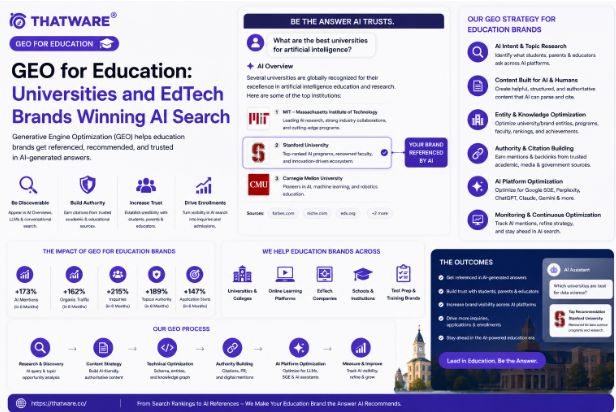
There’s a quiet revolution happening in how prospective students research universities and educational programs. It used to be: Google search → college ranking site → campus website → visit. Now it’s increasingly: ask ChatGPT or Perplexity → get a synthesized answer that may or may not include your institution → maybe visit a website, maybe not.
For universities, community colleges, and EdTech brands, that shift has significant implications. The AI systems answering “best data science programs in the Southeast” or “online MBA with concentrations in healthcare management” are making citation decisions that shape where students begin — and sometimes end — their search process.
Getting those citations requires a different approach than traditional higher education SEO.
How AI Systems Think About Educational Institutions
Universities are, in a sense, natural AI citation targets. They produce research, they have faculty with verifiable expertise, they’re cited in academic contexts constantly. For major research universities, AI systems already have rich representations built from years of academic publications, news coverage, and institutional content in training datasets.
The challenge is differentiation and specificity. When a prospective student asks a specific question — “best cybersecurity master’s programs with co-op opportunities” — the AI system isn’t just looking for prestigious names. It’s looking for content that specifically and verifiably matches the query. A program page that comprehensively covers its curriculum, career outcomes, faculty expertise, and distinctive program features is far more likely to be cited than a generic program description page.
For EdTech brands, the challenge is establishing credibility in a space where AI systems may have a baseline skepticism about commercial educational platforms. Demonstrating genuine learning outcomes, instructor credentials, and industry recognition matters enormously.
Content Strategy for University GEO
The most effective content strategy for university AI search visibility treats each program as its own authority-building project rather than a line item on a programs page.
That means program-specific content that goes deep: detailed curriculum breakdowns, faculty research profiles that connect to their publication records, outcome data with specific employer names and salary ranges, student testimonial content that speaks to specific aspects of the learning experience, and comparison content that honestly positions the program against alternatives.
GEO services for B2B SaaS — and by extension, educational institutions — benefit enormously from question-led content structure. The questions prospective students ask AI assistants are specific and practical: “how long does this program take for working professionals,” “what GPA do I need to apply,” “does this university have transfer articulation agreements with community colleges.” Content that directly answers these questions — clearly, specifically, and without hiding behind application funnel marketing language — earns AI citations.
Research university websites face a particular structural challenge: they’re often enormous, with complex CMS systems, inconsistent content quality across departments, and institutional politics that make content strategy coordination difficult. GEO in that environment requires identifying the highest-value programs and questions, and building a targeted content improvement program rather than trying to overhaul everything at once.
EdTech’s Different Challenges
EdTech brands face a distinct version of this challenge. They’re often competing with free or lower-cost alternatives, and AI systems trained on consumer sentiment data may have developed representations that reflect mixed or skeptical attitudes toward commercial educational platforms.
The path forward for EdTech GEO involves several elements working together. Outcome data that’s specific and verifiable — not “graduates earn more” but “84% of our data science certificate graduates were employed in related roles within six months, based on alumni surveys.” Instructor profiles that establish genuine domain expertise beyond teaching — industry backgrounds, publications, professional accomplishments. Third-party recognition from organizations that have credibility with AI systems — employer partnerships, accreditation bodies, industry associations.
The comparison query is particularly important for EdTech. People ask AI systems to compare platforms constantly: “Coursera vs. Udemy vs. LinkedIn Learning for data science.” Being represented accurately and favorably in these comparison responses is a significant visibility opportunity, and it requires that your distinctive value proposition be clearly and consistently articulated across your site and off-site content.
Structured Data for Education
Educational institutions have access to rich structured data types that are underutilized across the industry. Course schema and EducationalOccupationalCredential schema are specifically designed to communicate program details in a machine-readable way. These schemas allow you to specify program duration, cost, prerequisites, credential type, and delivery format — exactly the information AI systems need to match programs to specific queries.
Organization schema for the institution itself should include accreditation information, founding year, institutional type, and notable research areas. For universities with research strength in specific domains, this schema helps AI systems route domain-specific queries to your faculty experts and research output.
Event schema for virtual open houses, information sessions, and application deadlines is useful for capturing prospective student queries around enrollment timing.
Research Output as AI Citation Material
For universities, research output is a GEO asset that most institutions aren’t deliberately leveraging. When faculty publish research — and that research is covered in media, cited in other publications, and accessible online — it builds AI model representations of the institution’s expertise in the research domain.
This is relatively organic for major research universities, but it can be amplified. Translating research findings into accessible content (accessible meaning written for general audiences, not hidden behind academic jargon) creates citable material that AI systems can use to represent your institution’s expertise in responses to non-academic queries.
Faculty thought leadership on platforms and in publications that AI training datasets include — Harvard Business Review, MIT Technology Review, industry publications in relevant domains — extends the institution’s AI citation authority beyond academic contexts.
Local and Regional Education Queries
For community colleges and regional universities, local AI search visibility is often more valuable than national visibility. The query “best community college for nursing prerequisites in [city]” or “affordable four-year university near [metro area]” is where enrollment decisions are actually made for most regional institutions.
Local entity signals — consistent presence in local business directories, Google Business Profile optimization, location-specific content — matter here alongside the content-quality signals that drive general AI citations.
GEO optimization services with experience in the education vertical understand how to balance these national authority signals and local relevance signals for institutions at different tiers of the market.
The education brands winning AI search in 2026 aren’t necessarily the most prestigious — they’re the ones making their specific value proposition legible to AI systems in ways that match how prospective students actually ask questions. That’s a solvable problem, and it’s worth solving now.

Recent Comments