

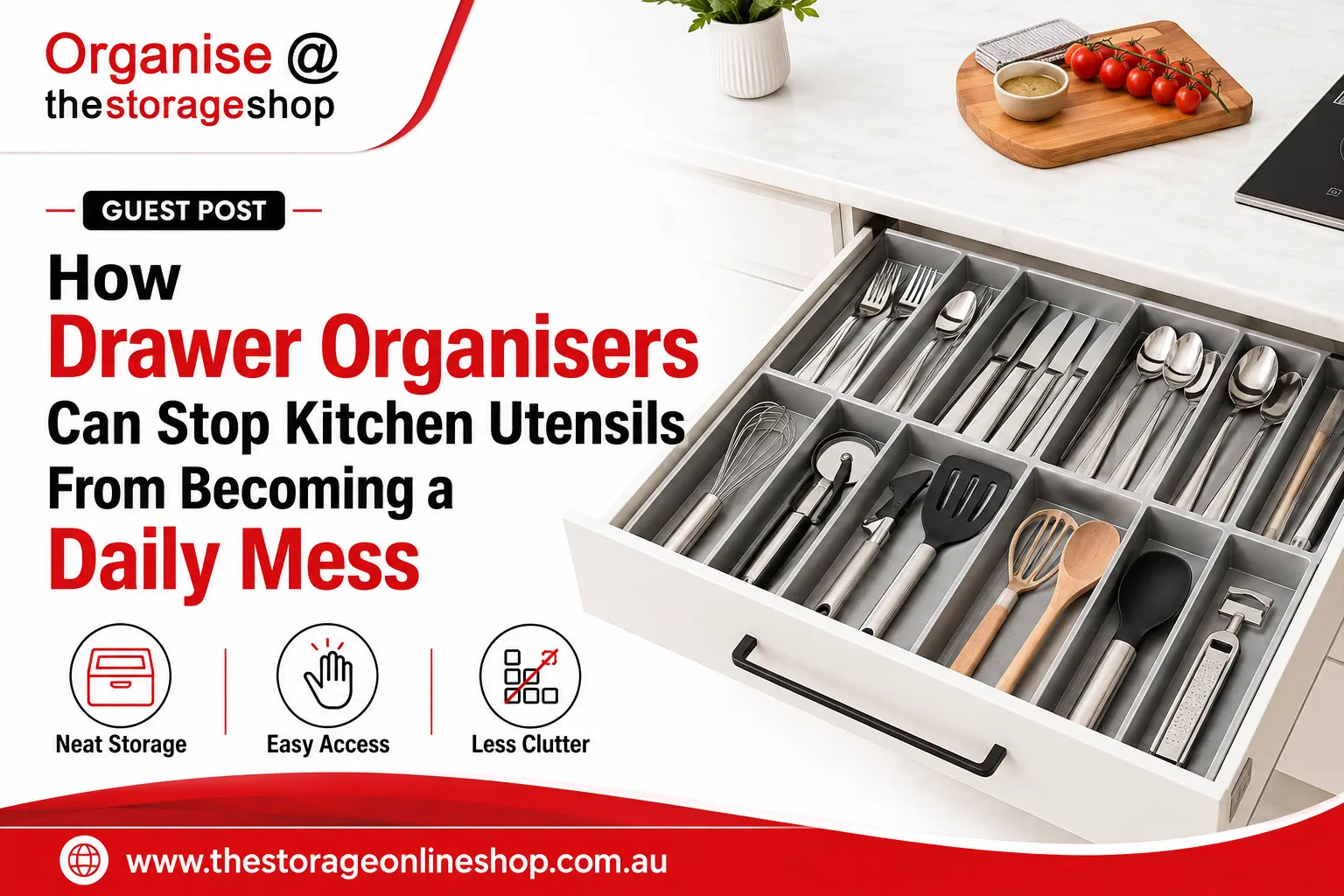
A kitchen drawer can become disorganised remarkably quickly. Spoons slide beneath larger tools, peelers disappear at the back and everyday utensils end up mixed with items that are used only occasionally.
Using kitchen drawer organisers can create defined locations for different tools, making the drawer easier to use without necessarily increasing its physical size.
The goal is not to create a perfectly arranged display. It is to reduce the small amount of searching and rearranging repeated throughout the day.
Empty the Drawer Completely
The easiest way to organise a cluttered drawer is to start with nothing inside it.
Place every item on the benchtop and group similar tools together. This reveals duplicates and rarely used items that are difficult to notice when everything is stacked.
Common groups include:
-
Everyday cutlery
-
Cooking spoons
-
Peelers
-
Measuring tools
-
Bottle openers
-
Tongs
-
Small baking tools
-
Specialist utensils
Do not return anything to the drawer until the available space has been measured.
Measure the Interior Accurately
A drawer organiser must fit the internal dimensions, not simply the width of the drawer front.
Measure width, depth and usable height. Check whether the drawer narrows around runners or construction details.
Drawer organiser selection becomes easier once you know the maximum dimensions that can sit inside without interfering with closing.
Give Frequent Tools the Best Positions
Organisation works best when it reflects frequency of use.
Place everyday items near the front or in the easiest compartments. Specialist tools can sit towards the rear.
Organise by Task, Not Just Shape
Two similarly sized utensils may be used for completely different purposes.
Keep related items together
For example, measuring spoons and measuring cups can share a zone even if their shapes differ. Tools used while preparing coffee or baking can also be grouped where practical.
This approach makes a utensil drawer organiser support kitchen routines rather than simply creating visually equal compartments.
Avoid Keeping Every Utensil in One Drawer
A large drawer is not automatically the right place for every small tool in the kitchen.
Remove rarely used speciality items and consider another storage location. This creates enough space around everyday utensils so the organiser can actually maintain separation.
Kitchen drawer organisers cannot solve overcrowding if the drawer contains far more objects than the available compartments can reasonably hold.
Match Compartments to Actual Tools
Long cooking utensils require different storage from teaspoons.
Before purchasing an utensil drawer organiser, measure some of the longest tools you plan to store.
An utensil drawer organiser with numerous small compartments may look efficient but become frustrating if spatulas, whisks or tongs do not fit.
Make Use of Drawer Depth
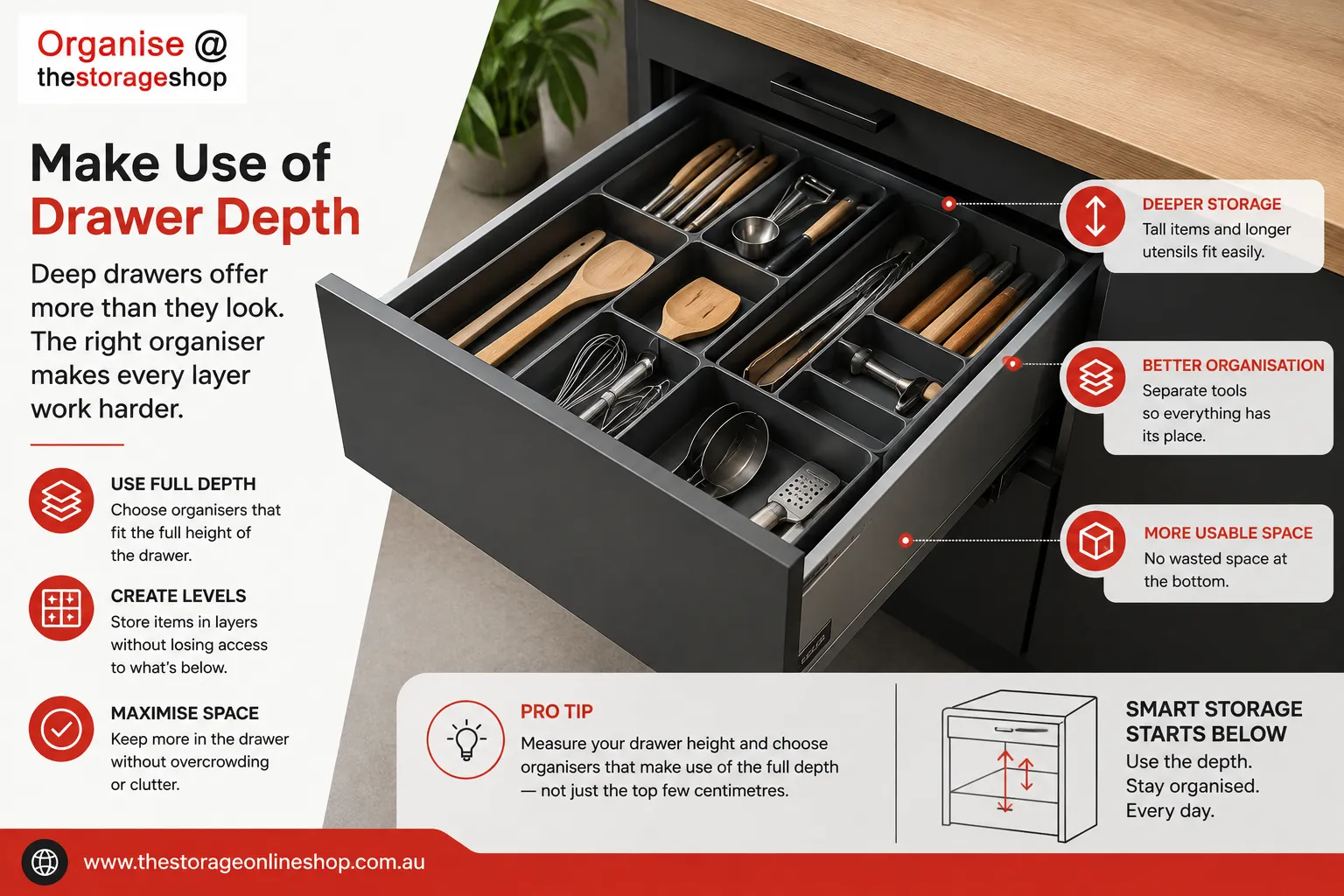
Some drawers offer more depth than a traditional flat cutlery tray uses.
Depending on the layout, deeper compartments or layered storage can sometimes help use that volume more effectively.
However, avoid stacking tools so heavily that you must remove several items to reach the one underneath. Accessibility is more important than maximising every cubic centimetre.
Create a “Daily Use” Zone
Identify the five to ten tools used most often and give them the easiest positions.
These might include a vegetable peeler, scissors, bottle opener or commonly used cooking utensils.
Keep the System Easy to Reset
Organisation should survive normal use.
Make each item’s home obvious
If the household has to think carefully about where a spoon or peeler belongs, the system is unlikely to remain tidy. Clear categories make it easier for everyone to put items back correctly.
Revisit the Drawer After a Week
An organisation system often needs small adjustments after real use.
If one compartment constantly overflows while another remains empty, redistribute items. If a frequently used tool sits in an awkward position, move it.
A drawer organiser should adapt to the household rather than forcing the household to follow an impractical layout.
Reduce Duplicate Utensils
Multiple versions of the same tool can consume a surprising amount of drawer space.
Keep the versions actually used and relocate or remove unnecessary duplicates. This can create more improvement than buying a larger organiser.
Kitchen drawer organisers perform best when they are dividing a sensible number of utensils rather than containing clutter in smaller compartments.
Why Choose Us
The Storage Online Shop provides kitchen-interior products intended to help households make cabinetry easier to use. Organisation products can be selected according to actual drawer dimensions and the types of utensils that need storage.
A measurement-first approach makes it easier to choose a layout that supports everyday access rather than simply looking tidy when first installed.
About Us
The Storage Online Shop focuses on practical kitchen-storage solutions for drawers, cabinets and other interior spaces. The aim is to help households organise commonly used items within existing cabinetry.
For anyone considering an utensil drawer organiser, the most useful first step is identifying what genuinely needs to stay in the drawer and measuring the space accurately.
Conclusion
A tidy utensil drawer does not require complicated rules. Remove unnecessary items, group tools by use and create easy-to-understand compartments for the utensils reached for most frequently.
A suitable organiser then gives those categories physical boundaries, making the drawer quicker to use and much easier to reset after cooking.

Recent Comments